



-
The Art of Peace: Peace Is a Thread That Doesn’t Break
Zijun Ginny Lin Reimagines Stillness at UNESCO Youth Exhibition Inside the luminous exhibition hall of the Catholic University of America, where people from over 20 nations have convened for UNESCO’s Voices of Impact: Youth Ideas for SDG Solutions, one installation stands apart—not by its scale or spectacle, but by its quiet persistence. Titled States of Peace, the multi-piece sculptural work by artist Zijun (Ginny) Lin does not shout, but hums—softly, symbolically, deliberately. It offers no solutions, no proclamations. Instead, it offers presence. “Peace is not a declaration,” Ginny tells in a soft, clear voice. “It’s a thread you choose not to cut. It’s a boat that keeps floating even when the water is still.” A Personal Vocabulary of Peace Turning 18 this year, Ginny was selected in this year’s Voices of Impact showcase, sharing her story and perspectives on peace. While many participants bring proposals in public policy, environmental engineering, and AI governance, Ginny brings yarn, brass, childhood drawings, and memory. “I grew up understanding peace as a word in textbooks,” she reflects. “But I wanted to understand how it feels—viscerally, emotionally, even spiritually. That’s where the work began.” Her installation comprises five sculptural works that unfold akin to a visual poem. Despite their material differences—brass, glass, acrylic, yarn—they are unified by a singular narrative arc: peace as motion, memory, structure, sensation, and struggle. Youth and SDG 16: A New Vocabulary for Justice and Peace States of Peace is Ginny’s response to SDG 16: Peace, Justice, and Strong Institutions. But unlike conventional interpretations rooted in law, governance, and diplomacy, Ginny’s work brings an affective lens. She asks: What if peace is not something we legislate, but something we practice in the emotional textures of daily life? “I want viewers to linger, not to agree with me,” she says. “If they leave thinking about a thread that didn’t snap, or a drawing that wasn’t erased, then that’s enough.” Her installation was one of the most visited during the opening day, with delegates and students returning for a second, even third look. Some took photographs. Others stood in silence. A few wept. Beyond the Gallery: The Future of Soft Resistance Ginny’s approach—what some curators are calling “soft resistance art”—is grounded in care, ambiguity, and personal memory. Her works do not resolve tension; they hold it. They are invitations rather than declarations. When asked what’s next, Ginny smiles: “Maybe more boats. Maybe more threads. But always more listening.” As States of Peace continues to resonate across audiences, it’s clear that Ginny has found not just a medium, but a message. In a world addicted to speed and certainty, she reminds us that sometimes the strongest gesture is to stay still—and listen. About the ArtistZijun (Ginny) Lin is a student artist from the Peddie School. She’s working at the intersection of sculpture, memory, and peace studies. Her work often draws from Buddhist philosophy, Chinese poetics, and feminist material practices. States of Peace marks her first exhibition with UNESCO Center for Peace and her debut in Washington, D.C.
22 September 2025 -
Staging Peace in Fragile Gesture
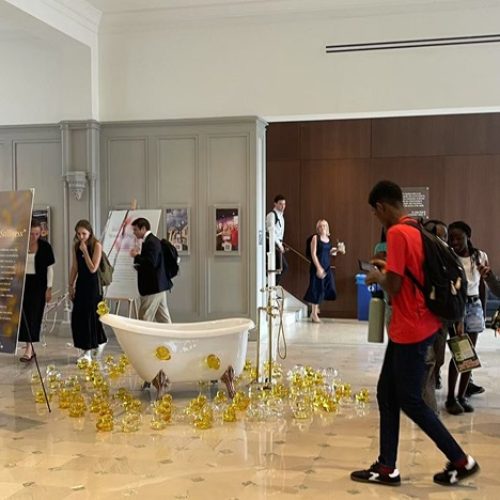
UNESCO Voices of Impact: Youth Ideas for SDG Solutions Interviewer: Thank you for joining us. Your exhibition States of Peace has drawn quiet but profound attention. To begin, could you tell us about the central question your work is asking? Ginny: Thank you. I think at the heart of States of Peace is a question that doesn’t ask for resolution, but for presence: Can peace exist not as an endpoint, but as a continuous negotiation of difference, memory, and stillness? My works don’t try to define peace—they stage it. They make space for viewers to sit with its fragility and complexity. Interviewer: The exhibition brings together five sculptural installations. How did these individual pieces come together to form a unified narrative? Ginny: Each piece began from a different emotional or cultural thread—childhood, memory, displacement, power, and play. But as they developed, I realized they were speaking to each other. A brass vessel shaped like a fig leaf recalls ancient poetry, while a bench made of transparent acrylic reimagines power as something fluid and balanced. The ducklings in the bathtub recall a child’s mind untouched by fear. Together, these works offer glimpses of peace—not loud declarations, but soft Staging Peace in Fragile Gesture Interviewer: The piece with salvaged window frames and childhood drawings is especially moving. Can you share its personal significance? Ginny: That piece is very personal. The window frames come from buildings marked by time and migration, their paint peeling, hinges rusted. Inside each pane, I etched drawings from my childhood—fantastical animals, homes, flowers. They speak to a moment before fear took hold. The installation holds these two layers of time together: the innocence that remains, and the structural decay around it. It’s about how memory endures even through rupture. Interviewer: Your use of materials—glass, brass, yarn—is very intentional. How do you think materiality influences the message? Ginny: I work with materials that are transparent, reflective, or soft. Glass, for example, is fragile yet enduring. It captures light just as memory captures emotion. Yarn knots, binds, and unravels—it’s tactile, relational. Brass carries historical and spiritual significance. These materials allow tension and tenderness to coexist. They’re not just mediums—they’re metaphors. Interviewer: There’s a recurring theme of childhood and imagination throughout the exhibition. Why revisit that space? Ginny: Because that space, even if fleeting, is where many of us first knew peace—not as an abstract concept, but as a feeling. The bathtub filled with amber ducklings invites us back to that sensory calm. It’s not about nostalgia, but about remembering our capacity for softness. In a world that values speed and certainty, I wanted to create a space where slowness and ambiguity could be embraced. Interviewer: One of the final pieces, the woven circular form, stands out as both chaotic and unified. What was your idea behind it? Ginny: That piece embodies the paradox of coexistence. The threads pull in different directions—some tight, some loose, some unraveling. They represent the tensions and connections between cultures, identities, and histories. Peace isn’t the absence of conflict but actively weaving through knots, accepting frictions, and finding temporary balance. Interviewer: If there’s one main message you want audiences to take away, what would it be? Ginny: I hope they leave not with answers, but with resonance—a gentle echo that encourages them to keep weaving. Peace doesn’t need to shout. Sometimes it expresses itself most powerfully through quiet gestures—through stillness, remembrance, and the refusal to forget. Interviewer: The piece with salvaged window frames and childhood drawings is particularly moving. Can you share its personal significance? Ginny: That work is deeply personal. The window frames were sourced from buildings marked by time and migration, their paint peeling, hinges rusted. Into each pane, I engraved drawings from my childhood—fantastical animals, homes, flowers. They speak to a moment before fear. The installation holds these two temporalities together: the innocence that remains, and the structural decay around it. It’s about how memory persists even through rupture. Interviewer: Your use of materials—glass, brass, yarn—is very deliberate. How do you think materiality shapes the message? Ginny: I work with materials that are transparent, reflective, or soft. Glass, for example, is fragile but enduring. It captures light the way memory captures emotion. Yarn knots, binds, and unravels—it’s tactile, relational. Brass has historical and spiritual weight. These materials allow tension and tenderness to coexist. They are not just mediums—they’re metaphors. Interviewer: There’s a recurring motif of childhood and imagination throughout the exhibition. Why return to that space? Ginny: Because that space, however fleeting, is where many of us first knew peace—not as a concept, but as a feeling. The bathtub filled with amber ducklings is an invitation back to that sensory quiet. It’s not about nostalgia, but about remembering the capacity for softness. In a world that pushes speed and certainty, I wanted to stage a space where slowness and ambiguity could be held. Interviewer: One of the final pieces, the woven circular form, stands out as both chaotic and unified. What was your intention there? Ginny: That piece embodies the paradox of coexistence. The threads pull in different directions—some tight, some slack, some unraveling. They represent the simultaneous tensions and connections between cultures, identities, and histories. Peace isn’t the absence of conflict, but the active practice of weaving—of working through knots, accepting frictions, and finding temporary balance. Interviewer: If there is one takeaway you hope audiences leave with, what would it be? Ginny: I hope they leave not with answers, but with resonance—a soft echo that invites them to keep weaving. Peace doesn’t need to shout. Sometimes it performs most powerfully through quiet gestures—through stillness, remembrance, and the refusal to forget.
21 September 2025
“The results were clear, professional, and persuasive, and the investors and advisors who have seen the materials loved them. They know what investors want!”
