


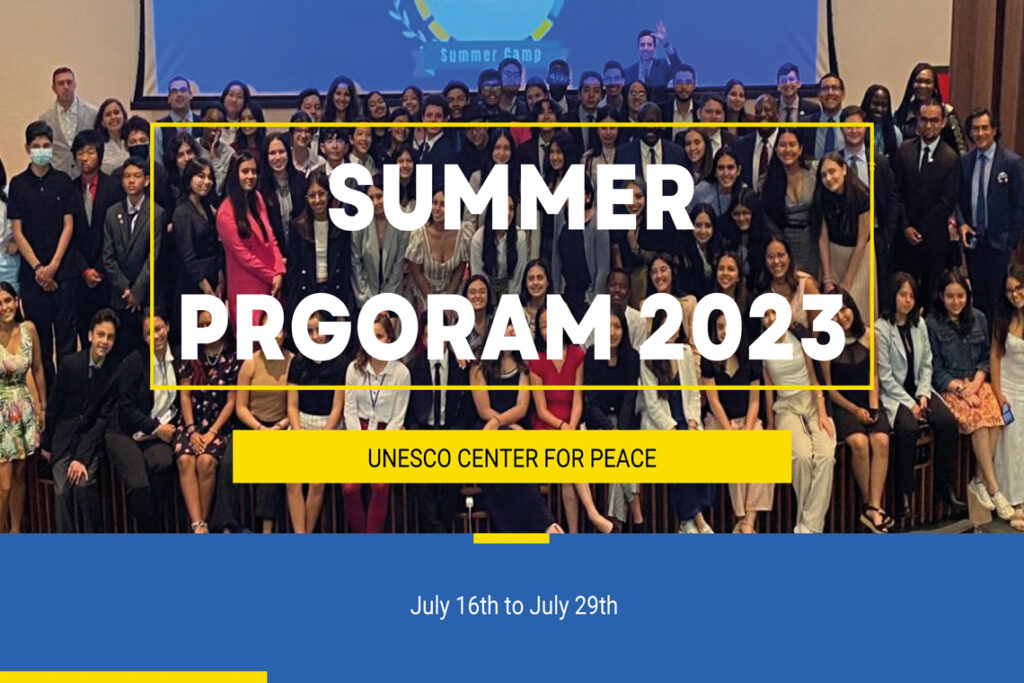
-
On behalf of the UNESCO CENTER FOR PEACE we wishes you a wonderful 2023
None of this is possible without your support, so thank you for being an important part of the UCP family. We appreciate your engagement, commitment and support to help impact the community See you soon peacemakers — hyper bien, à Worldwide.
4 December 2022 -
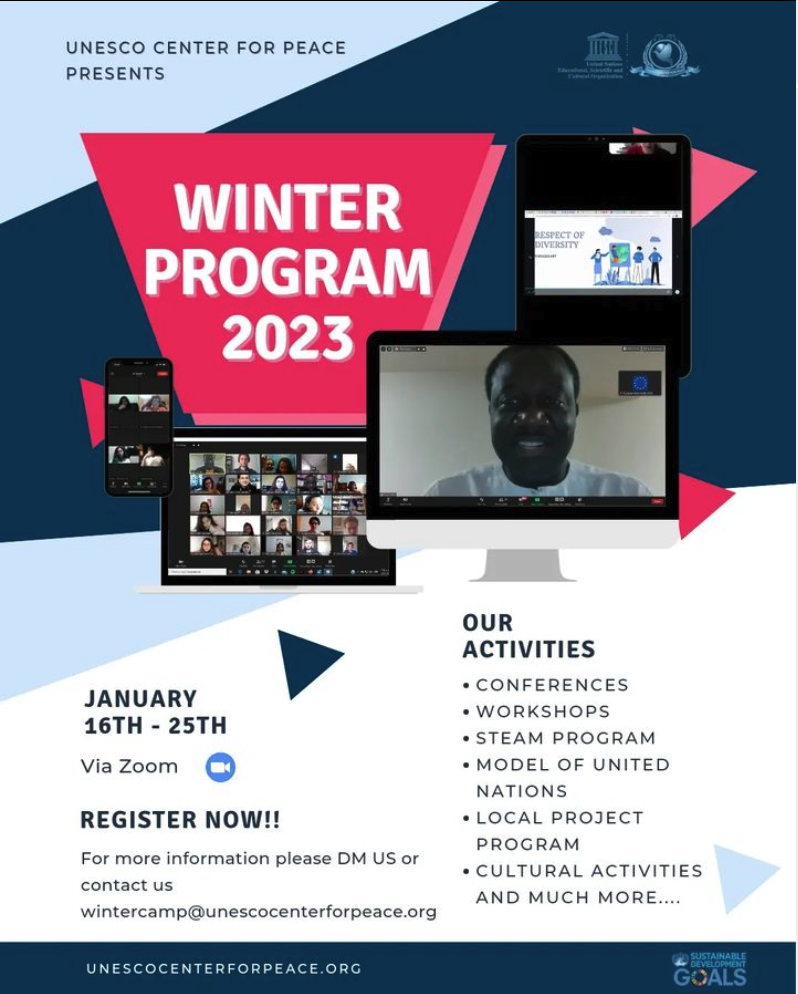
Winter Program will be held from January 16th to January 25th via zoom
We invite you all to the UCP VIRTUAL PROGRAM 2023. Winter Program will be held from January 16th to January 25th via zoom We want to gather as many delegates as possible and to make this an amazing opportunity to grow. Can you help us? The registration process is pretty easy : 1. Go to our Instagram bio and click on the link then click on the registration tab or click here: https://docs.google.com/…/1FAIpQLSe1kX98mpReFb…/viewform 2. Complete all your information, your favorite program and payment 3. You will receive an email the next weeks with all the information regarding your program
5 January 2023 -
King Bo Wang Interview Report
Interviewer: King Bo, thank you for being here. Let’s start at the beginning. How did Cut by the Border come into being? King Bo Wang: Thanks for having me! Honestly, it wasn’t some grand plan. I was just tagging along on a trip to Tijuana with my dad, thinking I might ask someone about tariffs or something “business-y.” But then I met Chava, working at a cardboard factory. He spoke perfect English and had this quiet confidence about him. When he told me he’d been deported at 18, right after 9/11, over something minor, it kind of stopped me in my tracks. I just asked if he’d be willing to talk more. One question turned into hours. Next thing I knew, I was deep into a story I never expected to find. Interviewer: You’re 17, still in high school. Yet, Cut by the Border is a remarkably mature piece of work, dealing with layered issues of migration, justice, and identity. What made you, as a student, take on something this complex? King Bo: Honestly? It sort of found me. I wasn’t out to make a film about deportation or immigration policy or anything like that. I just listened to Chava, and his story stuck with me. I realized, if I just moved on and pretended it never happened, I’d basically be adding to the silence he was talking about. I’m not a politician, and I definitely don’t have all the answers. I’m just a teen with a camera. But I could pay attention, and I could try to make sure his voice got heard. That felt like enough to start. Interviewer: You’re very intentional about giving space to people’s voices. How did you build that trust within your subjects? King Bo: I tried to make it feel less like an interview and more like a conversation. No lights, no scripts, just hanging out and talking. I always made sure they could see what I was recording, and if they wanted to stop, we stopped—no pressure. I’d show them clips as I edited, just to make sure they felt good about what was in there. Trust isn’t something you can rush; it builds if you keep showing up and listening for real, not just waiting to ask your next question. Interviewer: You chose to include your own voice in the documentary as voice-over. That’s not something all young directors would feel confident doing. Why did you make that choice? King Bo: That decision kept me up at night! I really didn’t want to turn it into “the King Bo journey in Mexico.” But after a while, I realized that pretending I wasn’t there was also a choice. Silence isn’t neutral—it says something, too. My voice ended up being a bridge between my interviewees and audience: not taking over, but letting viewers in on what it’s like to listen, as someone who’s maybe not supposed to be part of this story. I guess I wanted to be honest about where I was coming from. Interviewer: In the film, you’ve also interviewed some of Chava’s co-workers. One of them says, “You have to learn to stay invisible.” That’s a line that says a lot without making a fuss. How did that moment strike you as a filmmaker? King Bo: That line hit hard. It made me realize some folks have to blend in, not because they’ve done anything wrong, but because it’s safer that way. For some people, keeping your head down is just basic survival. It really made me think about how much people adapt to circumstances, sometimes in ways nobody even notices. Interviewer: Your film also includes insight from Dr. Linford Fisher, a historian at Brown University. He talks about how the U.S.–Mexico border wasn’t always fixed, and the movement used to be normal. Why did you feel it was important to include that historical perspective? King Bo: I think it’s easy to forget the border hasn’t always been what it is now. Dr. Fisher’s perspective really blew my mind—I hadn’t thought about families just going back and forth like it was no big deal. And what he said totally lined up with what Rosendo, the factory guard, told me in our interviews. He talked about riding his bike across the border in the 90s—no big deal, just like visiting the next town. Hearing that made Chava’s story feel bigger. It’s not just about one person, but about a whole history of movement that got way more complicated over time. I wanted the audience to have that “wait, what?” moment too, where you realize how much things have changed. Interviewer: Did it change how you view the concept of a border? King Bo: Oh, for sure. Before, I thought borders were just big lines on a map, and that was that. Now I see it’s way messier—there are physical fences, yeah, but also all these invisible lines people deal with, like cultural stuff, laws, even how people treat each other. Some borders you see, others you just feel. Interviewer: In addition to the film, you also created a companion series of black-and-white photographs titled Cut by the Border. Can you talk about what drew you to still photography, and what you hoped to capture with these images? King Bo: For me, sometimes a single photograph can hold a whole story, even without words. While I was in Tijuana, I kept finding moments that felt impossible to explain with video alone—things like layers of missing person flyers peeling off concrete, locals on their phones just feet from the fence, or fruit vendors working right by the beach while seabirds flew past the border wall. The photos are kind of my way of slowing things down. I just wanted to show what I saw, and maybe let people draw their own conclusions about life at the edge. Interviewer: The film and your photos focus a lot on individual stories, but you also did a historical research paper for this project. What made
21 September 2025 -
Staging Peace in Fragile Gesture
UNESCO Voices of Impact: Youth Ideas for SDG Solutions Interviewer: Thank you for joining us. Your exhibition States of Peace has drawn quiet but profound attention. To begin, could you tell us about the central question your work is asking? Ginny: Thank you. I think at the heart of States of Peace is a question that doesn’t ask for resolution, but for presence: Can peace exist not as an endpoint, but as a continuous negotiation of difference, memory, and stillness? My works don’t try to define peace—they stage it. They make space for viewers to sit with its fragility and complexity. Interviewer: The exhibition brings together five sculptural installations. How did these individual pieces come together to form a unified narrative? Ginny: Each piece began from a different emotional or cultural thread—childhood, memory, displacement, power, and play. But as they developed, I realized they were speaking to each other. A brass vessel shaped like a fig leaf recalls ancient poetry, while a bench made of transparent acrylic reimagines power as something fluid and balanced. The ducklings in the bathtub recall a child’s mind untouched by fear. Together, these works offer glimpses of peace—not loud declarations, but soft Staging Peace in Fragile Gesture Interviewer: The piece with salvaged window frames and childhood drawings is especially moving. Can you share its personal significance? Ginny: That piece is very personal. The window frames come from buildings marked by time and migration, their paint peeling, hinges rusted. Inside each pane, I etched drawings from my childhood—fantastical animals, homes, flowers. They speak to a moment before fear took hold. The installation holds these two layers of time together: the innocence that remains, and the structural decay around it. It’s about how memory endures even through rupture. Interviewer: Your use of materials—glass, brass, yarn—is very intentional. How do you think materiality influences the message? Ginny: I work with materials that are transparent, reflective, or soft. Glass, for example, is fragile yet enduring. It captures light just as memory captures emotion. Yarn knots, binds, and unravels—it’s tactile, relational. Brass carries historical and spiritual significance. These materials allow tension and tenderness to coexist. They’re not just mediums—they’re metaphors. Interviewer: There’s a recurring theme of childhood and imagination throughout the exhibition. Why revisit that space? Ginny: Because that space, even if fleeting, is where many of us first knew peace—not as an abstract concept, but as a feeling. The bathtub filled with amber ducklings invites us back to that sensory calm. It’s not about nostalgia, but about remembering our capacity for softness. In a world that values speed and certainty, I wanted to create a space where slowness and ambiguity could be embraced. Interviewer: One of the final pieces, the woven circular form, stands out as both chaotic and unified. What was your idea behind it? Ginny: That piece embodies the paradox of coexistence. The threads pull in different directions—some tight, some loose, some unraveling. They represent the tensions and connections between cultures, identities, and histories. Peace isn’t the absence of conflict but actively weaving through knots, accepting frictions, and finding temporary balance. Interviewer: If there’s one main message you want audiences to take away, what would it be? Ginny: I hope they leave not with answers, but with resonance—a gentle echo that encourages them to keep weaving. Peace doesn’t need to shout. Sometimes it expresses itself most powerfully through quiet gestures—through stillness, remembrance, and the refusal to forget. Interviewer: The piece with salvaged window frames and childhood drawings is particularly moving. Can you share its personal significance? Ginny: That work is deeply personal. The window frames were sourced from buildings marked by time and migration, their paint peeling, hinges rusted. Into each pane, I engraved drawings from my childhood—fantastical animals, homes, flowers. They speak to a moment before fear. The installation holds these two temporalities together: the innocence that remains, and the structural decay around it. It’s about how memory persists even through rupture. Interviewer: Your use of materials—glass, brass, yarn—is very deliberate. How do you think materiality shapes the message? Ginny: I work with materials that are transparent, reflective, or soft. Glass, for example, is fragile but enduring. It captures light the way memory captures emotion. Yarn knots, binds, and unravels—it’s tactile, relational. Brass has historical and spiritual weight. These materials allow tension and tenderness to coexist. They are not just mediums—they’re metaphors. Interviewer: There’s a recurring motif of childhood and imagination throughout the exhibition. Why return to that space? Ginny: Because that space, however fleeting, is where many of us first knew peace—not as a concept, but as a feeling. The bathtub filled with amber ducklings is an invitation back to that sensory quiet. It’s not about nostalgia, but about remembering the capacity for softness. In a world that pushes speed and certainty, I wanted to stage a space where slowness and ambiguity could be held. Interviewer: One of the final pieces, the woven circular form, stands out as both chaotic and unified. What was your intention there? Ginny: That piece embodies the paradox of coexistence. The threads pull in different directions—some tight, some slack, some unraveling. They represent the simultaneous tensions and connections between cultures, identities, and histories. Peace isn’t the absence of conflict, but the active practice of weaving—of working through knots, accepting frictions, and finding temporary balance. Interviewer: If there is one takeaway you hope audiences leave with, what would it be? Ginny: I hope they leave not with answers, but with resonance—a soft echo that invites them to keep weaving. Peace doesn’t need to shout. Sometimes it performs most powerfully through quiet gestures—through stillness, remembrance, and the refusal to forget.
21 September 2025